Internal product · Applied AI · Construction
Ribalta AI budgeting and site planning
Internal platform that turns a bill of quantities into a priced budget in minutes and schedules sites, crews and machinery.

Overview
Ribalta i Fills is a family-owned public works and civil engineering company in the Catalan Pyrenees with around 80 people. I designed and built its internal platform: it reads bills of quantities in PDF or Excel with AI, prices every line item with the company's real historical prices and exports the branded Excel. Today it covers the whole life of a job: budgeting, monthly progress certificates and crew and machinery planning.
The challenge
Every budget was built by hand in Excel: 4 to 7 hours digging prices out of old files, with broken formulas and outdated rates. Crew and machinery planning lived on paper, with no alerts for deadlines or missing paperwork.
What I did
- Analysed how budgets were being made and wrote the feasibility study and proposal for management: cost, payback and a comparison with CYPE and Presto.
- Designed the product with its users: meetings with the company's team, priorities per module and iterated improvement lists.
- Built the app with AI-assisted development (Claude Code): 36 commits in three months, from budget estimator to construction CRM.
- Built the price database from the company's real budgets: 645 initial line items split into public and private works.
- Designed the AI pipeline: long documents read in chunks, prices looked up in batches and a different model for each task.
- Shipped it to production and keep extending it based on the team's requests.
How it works
Budgets in minutes
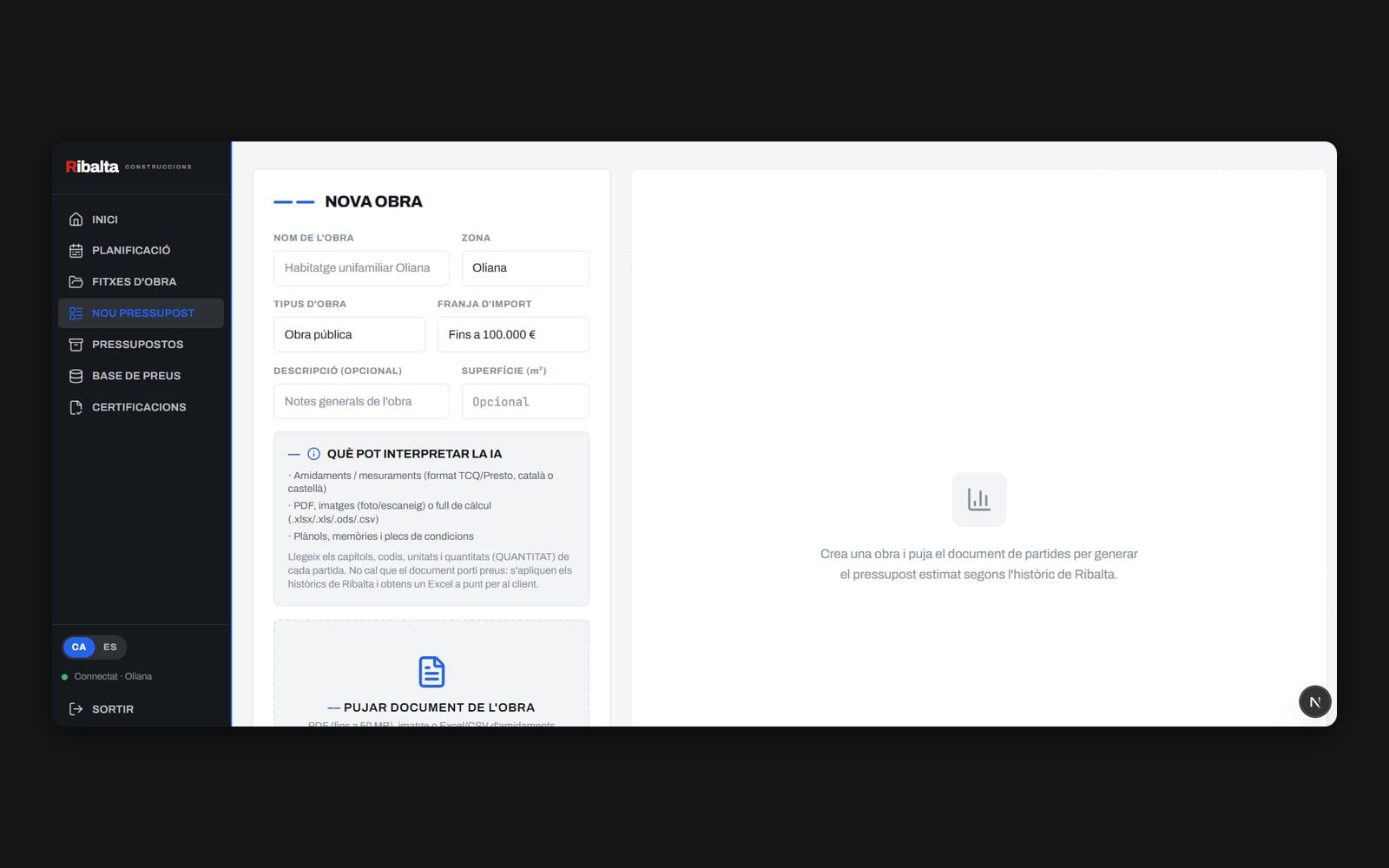
Text, PDF or Excel: the AI extracts each line item with its quantities and prices it—first from the company's history, then from the web, and otherwise with an estimate.
Reliability traffic light
Every line shows where its price comes from: green (Ribalta's history), yellow (web or AI), red (missing) and blue (no comparison). The colours carry over to the Excel.
Branded Excel export
Export with company branding, live formulas, a review sheet with filters, an editable tender discount and a summary with diagnosis and recommendations.
Human-reviewed price base
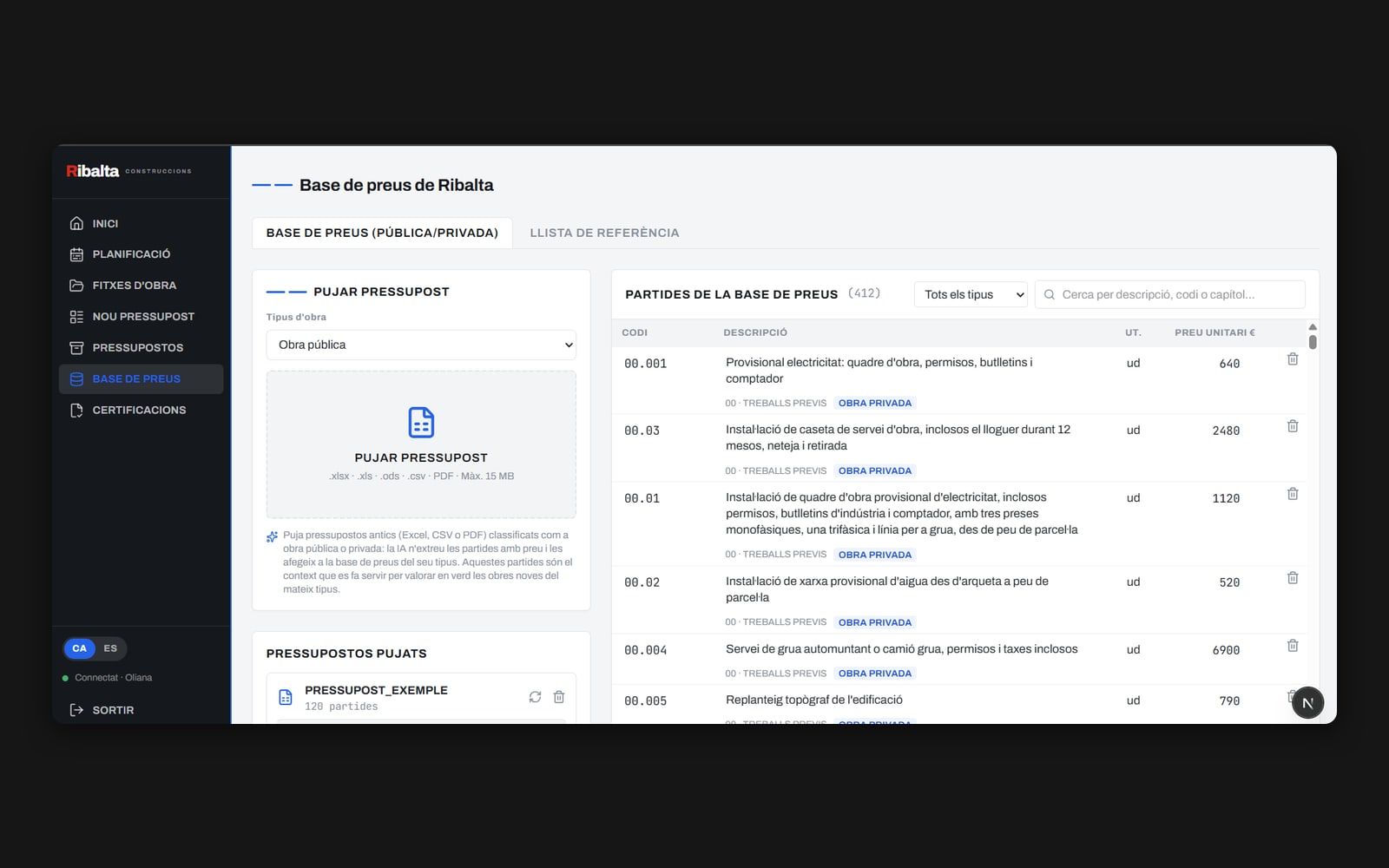
Own and reference line items, traceable to the job they came from. It only learns from Excels corrected by a person.
Progress certificates
Monthly progress certificates from the architect's budget (Arquímedes format or Excel), with formulas the council's surveyor can audit.
Planning and alerts
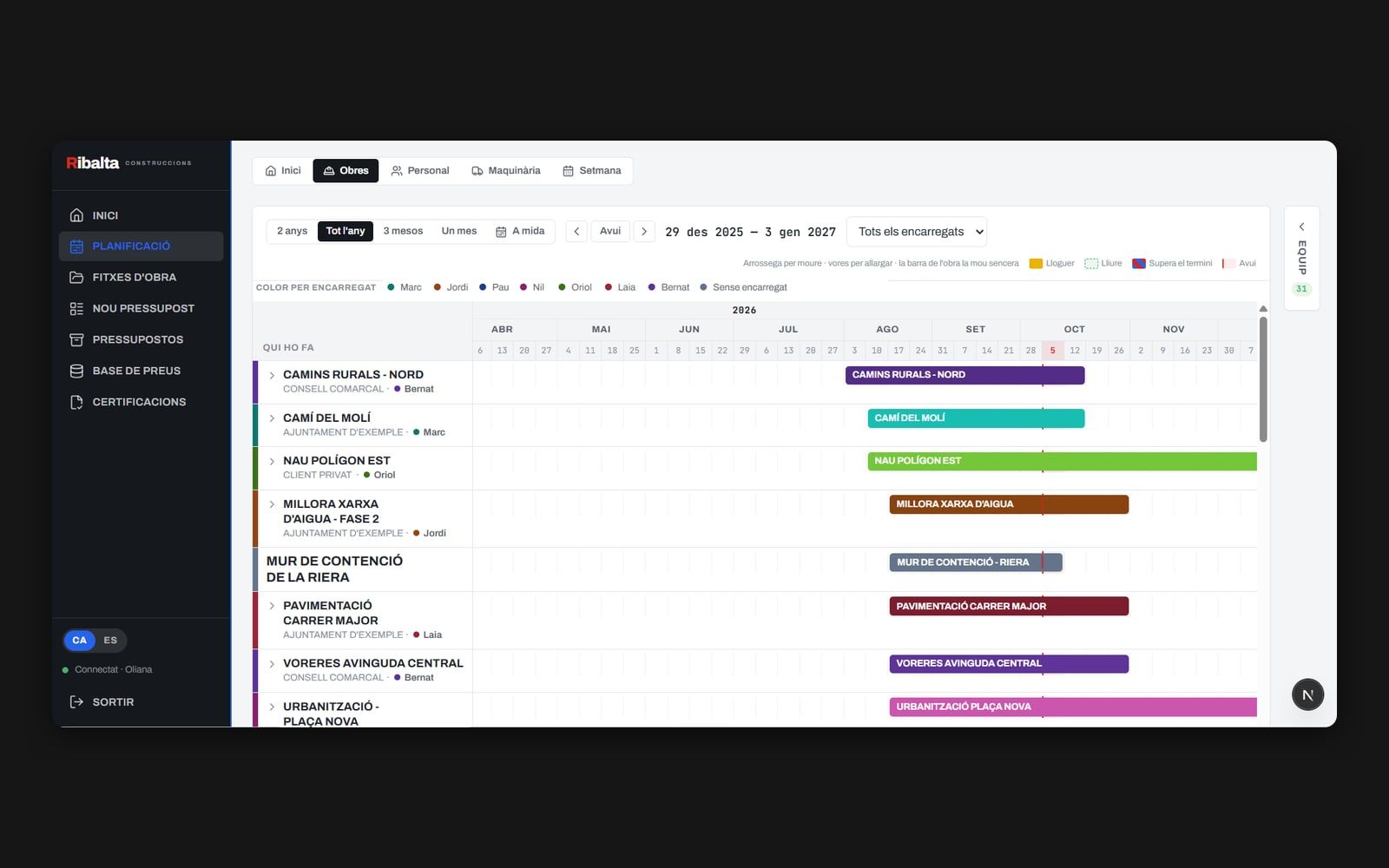
A Gantt of sites, crews and machinery with five views and an alerts engine: sites with no team, double-booked crews, penalty deadlines or missing paperwork. It's the most-used module.
Key decisions
- The edited Excel is the final number: I dropped an automatic budget–job–certificate link because technicians adjust the Excel heavily after exporting it.
- The price base only learns from human-reviewed Excels, so the system's own mistakes never become the reference.
- The cost module stays out of the menu: it's management information and must not look like a tool for cutting staff.
- Catalan first, a single accent colour and no new libraries for planning: the Gantt, alerts and charts are hand-built to keep it light and maintainable.
Results
- 6modules in production
- 645real line items in the initial price base
- 36commits between June and September 2026
- 4–7 h → 1.5 hper budgetTarget set in the feasibility study
Stack and tools
- Next.js 16
- React 19
- TypeScript
- Tailwind CSS v4
- shadcn/ui
- TanStack Table
- Supabase (PostgreSQL, Auth, Storage)
- Anthropic API (Claude Opus · Sonnet · Haiku)
- Anthropic web search
- pdf-lib
- Vercel
- GitHub
- Claude Code
Skills
- Product discovery with users
- UX for non-technical users
- Prompt engineering and LLM pipelines
- PostgreSQL data modelling
- Construction budgeting: quantities, line items, contract price and tender discounts
- Business case and ROI
- Project management with a real client
What I learned
- An internal tool works when it respects how people already work: Excel still rules, so the app feeds it instead of replacing it.
- Splitting AI work into chunks and batches is what makes long documents readable within serverless time limits.
- Picking the model per task—the strongest for hard documents, a balanced one for price lookups and a fast one for simple reads—balances quality and cost.
- Speaking the industry's language (quantities, certificates, tender discounts) speeds things up more than any feature.
Gallery